Someone asks what you want to do with your life and the room gets quiet. Not because you are avoiding the question — because you genuinely do not have an answer. You have browsed job boards, read the articles, maybe even talked to a coach. And you are still unsure, while everyone around you seems to have already arrived.
Here is the truth almost nobody admits: most people do not have it figured out. They made a choice early — by pressure, convenience, or what looked good on paper — and they have spent years convincing themselves it was right. You are not behind. You are not broken. You were simply never given a system for making this decision.

Why "pick something and work hard" fails
The advice you were handed is a lottery ticket: pick something, work hard, and figure it out along the way. It works for a lucky few. For everyone else, it produces years of trial and error, expensive degrees in the wrong field, and a quiet, persistent feeling that you missed the memo.
The cost is real and it compounds. Every year spent drifting in the wrong direction is a year you are not building in the right one — not just income, but skill, reputation, and momentum. The "figure it out later" plan charges interest.
Career choice is a solvable problem
A good career decision is built on three inputs, and all three can be measured:
- Who you are — your values, strengths, and interests, assessed with structure instead of vibes.
- What the market rewards — the fields that actually pay for what you are good at, not what the job boards romanticize.
- What kind of life you want — the hours, the geography, the energy, the freedom. A great career you hate living is not a great career.
Put those three together and "what should I do with my life" stops being a spiritual crisis and becomes a decision — with criteria, evidence, and a verdict.

Where AI makes this finally practical
The reason people stay lost is not lack of desire — it is the sheer work of self-assessment. Reflecting honestly, mapping your strengths, comparing options across weighted criteria: doable, but the kind of doable that never gets done on a Tuesday evening.
AI removes the friction: prompts that run your self-assessment, structured reflection that surfaces what you actually want — not what looks good on paper — and decision matrices that score your options instead of gossiping about them. AI is the career counselor you can afford to see every day.
Where you start this week
You do not need to know the answer before you start. That is the entire point:
- Run one structured self-assessment — values and strengths, answered honestly.
- Ask AI to surface careers that combine your strengths with fields the market rewards.
- Score your top three options on a weighted matrix — the winner and the backup become visible.
- Build a 90-day plan toward the winner — first steps, not a life sentence.
Six weeks of that produces something most people never have: a shortlist, a clear winner, a backup, and a plan. Not a vague idea — a decision.
The honest caveat
A system will not make the choice for you, and no assessment can guarantee a career. What it does is replace guessing with evidence — so the decision you make is informed, scored, and defensible. That is more than most people ever get.
Not knowing what you want to do with your life is not a flaw. It is a signal that you have not been given the right tools to figure it out.
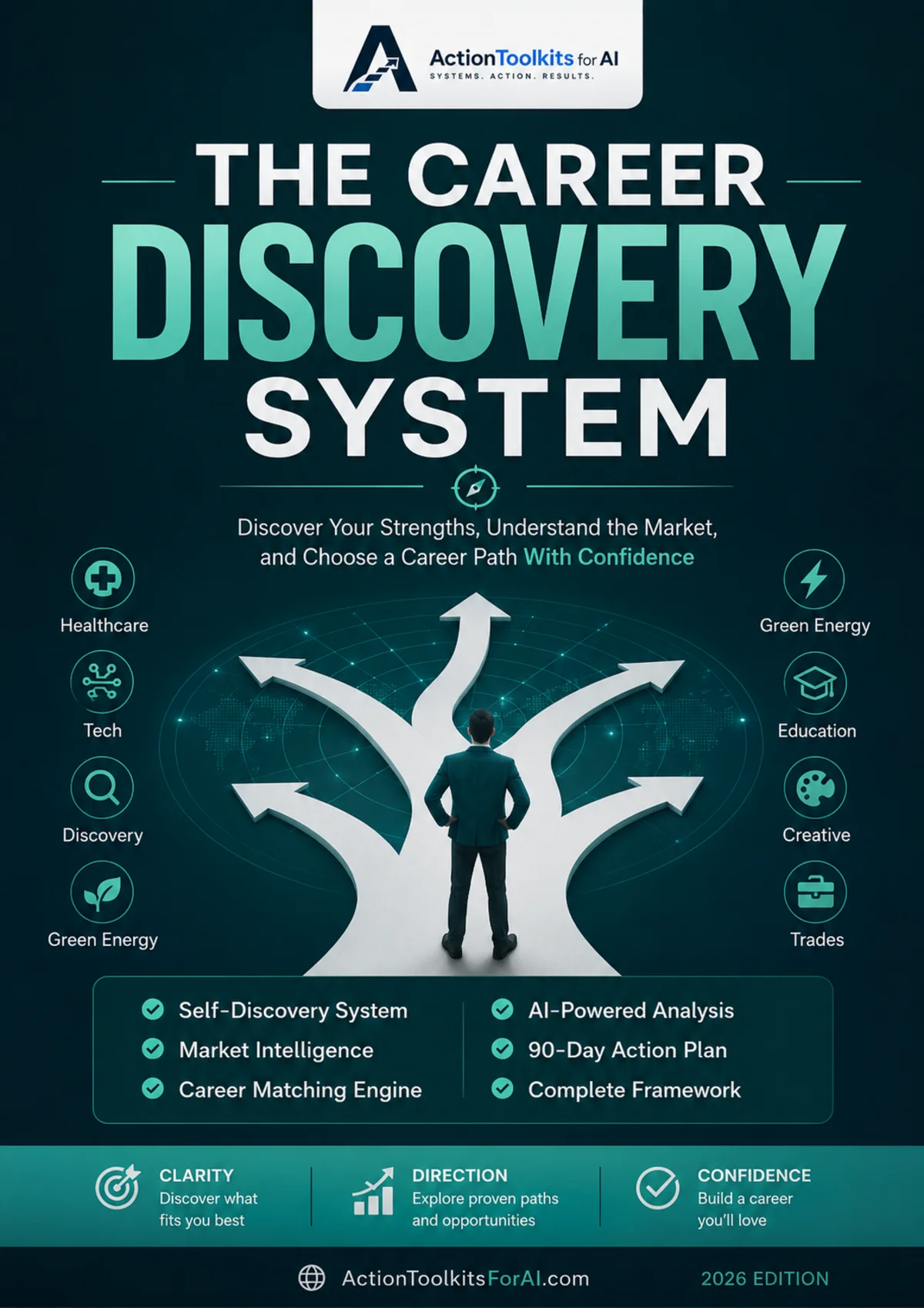
The tools — 47 pages, the values and strengths assessment, interest mapping, career exploration scorecards, AI reflection prompts, decision matrix templates, and the 90-day discovery plan — are in the toolkit below.