You read about AI every day. Productivity gains, cost savings, competitive advantage — the headlines are everywhere. Then Monday comes, you sit at your desk, and you do your job exactly the way you have always done it. You tell yourself you will "get to it," but the week fills up and the year is gone. And somewhere underneath, a quiet fear grows: everyone else is getting this, and I am falling behind.
Let us be honest about what is happening: AI is not replacing jobs — it is replacing the parts of jobs that waste time. The repetitive emails. The first drafts that take hours. The meeting notes nobody wants to write. The reports that would write themselves if someone just organized the data. Those tasks are draining your best hours — and AI can handle most of them in minutes.

The cost of doing nothing
You do not have to be replaced by AI to lose out. You lose out the moment a colleague starts delivering the same work in a quarter of the time — and takes on more, and looks better, and gets noticed. The gap is not between people who use AI and people who do not. It is between people who started and people who are still waiting for the "right moment."
The right moment is never coming. The tools are free to try, they are better than last year, and they are improving every month. The only thing a waiting strategy produces is a bigger gap.
What "using AI at work" actually means
It is not "ask ChatGPT to do my job." It is a specific, practical thing: identifying the tasks in your workflow that AI is genuinely good at, and giving it the context to do them. The honest list looks like this:
- Emails and communication — first drafts, rewrites, the follow-ups you keep postponing.
- Meetings — notes, summaries, action items, instead of the scramble after every call.
- Reports and documents — turning scattered data into something presentable in minutes.
- Presentations and plans — the structure, the outline, the slide text that eats your evenings.
- Research and prep — the background work that currently means staring at a search bar.
Every role has its own version of that list. A manager’s looks different from a salesperson’s, which looks different from an admin’s. The toolkit maps to your role precisely — because generic AI advice is exactly why you have not started.

Why you have not started yet
Be honest about the real blockers — they are not laziness:
- Nobody showed you where AI fits in your actual job — just scary headlines.
- You tried once, got generic fluff, and concluded it was overhyped.
- You do not know what to ask, or how to give it the context it needs.
All three are solved the same way: ready-made prompts for your role, tested, with the context baked in. Copy, paste, get a usable result — not a vague essay. That is the difference between a tool that impresses and a tool you abandon.
Where you start this week
One experiment is worth fifty pages of theory:
- Find the task that annoys you most this week — the one you keep procrastinating.
- Give AI the context and ask it to produce a first draft you can edit.
- Time yourself: first draft to final, and compare it to last week.
- Take the reclaimed hour and do the work that only you can do.
That single experiment teaches you more than any tutorial. Once you see AI handle a task that used to take you an hour, you will not look at your workday the same way again.
The honest caveat
AI will not make you indispensable by itself — it is a multiplier, and what you multiply still has to be your judgment, your relationships, and your results. What it does is reclaim the hours you are currently losing to busywork, so you have time for the parts of your job that actually matter.
AI does not replace your job. It replaces the tasks that waste your best hours. This toolkit shows you exactly which ones.
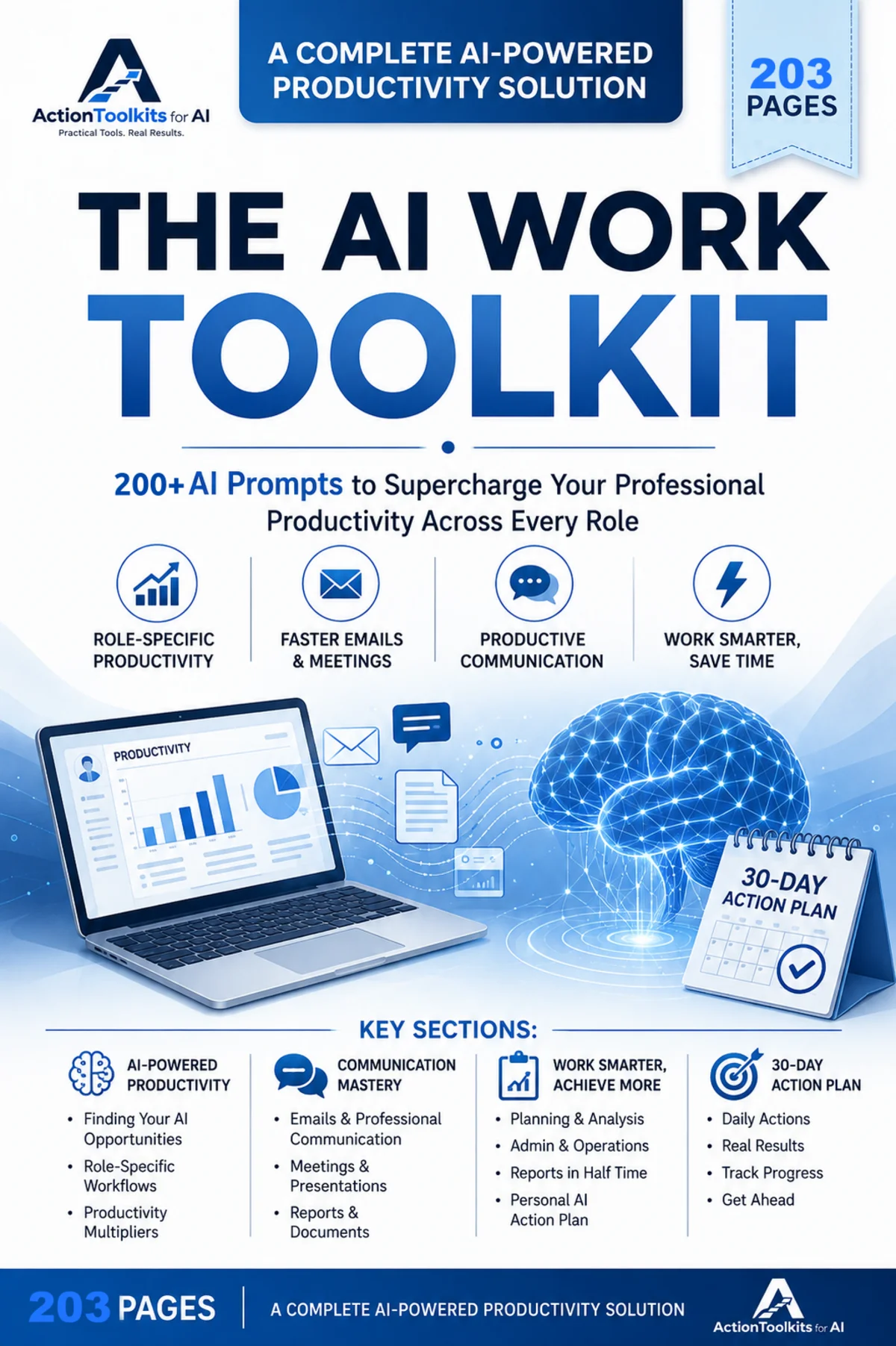
The map to those tasks — 90 pages, the AI opportunity map for your role (manager, sales, marketing, HR, project management, customer service, admin), 90+ ready-to-use prompts, and the 30-day action plan — is in the toolkit below.