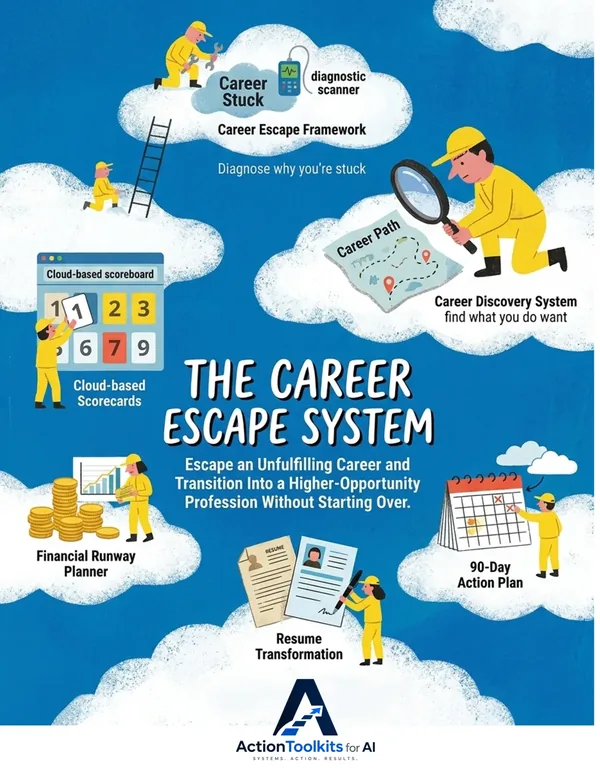
Sunday evening arrives and something sinks in your chest. The weekend is ending, and Monday is a wall. You have felt it for months — maybe years — and you have cycled through the usual options: "just push through," "it will get better," "everyone hates their job." None of them stick. The feeling comes back every single week.
Here is the part nobody tells you: that feeling is not weakness. It is data. It is your honest reaction to spending half your waking hours on something that does not use what you are good at. The reason you stay is not that you are trapped — it is that leaving feels like a financial cliff you are not ready to jump off.

Why "just quit" is terrible advice
Quitting without a plan trades one kind of stress for a worse one. No income, a ticking clock, and a job search done from a place of desperation — that is how people end up taking the next wrong job just to stop the bleeding. The instinct to escape is right. The method is what fails.
The alternative is not a leap of faith. It is a runway: you build the plan, the skills, and the financial buffer while your paycheck is still arriving. You leave because you are ready — not because you are desperate.
The escape is a sequence, not a feeling
People who successfully change careers rarely do it by luck. They run a process, even if they do not call it that:
- Diagnose — name specifically what is wrong. "I hate my job" is not actionable. "I do no deep work, I am undervalued, and the industry is shrinking" is.
- Discover — figure out what you actually want next, using structure instead of vibes. Values, strengths, the kind of life you are building.
- Decide — score the real options against a clear criteria list, including the option to stay.
- Plan the runway — the financial buffer and income bridge that make the move possible without panic.
- Reposition — transform your resume and LinkedIn around the new direction before you talk to anyone.
- Execute — move on your timeline, not on the market’s.
Every one of those steps can be worked in evenings and weekends. That is the entire trick — the escape happens while you still have the safety of a paycheck.

Where most people get stuck
The number one trap is the diagnosis stage. "I hate my job" gets answered with a job search — same kind of job, new company, same sinking feeling six months later. If you skip the diagnosis, you do not change careers. You change parking spots.
The second trap is the finances. People stay for years because they never quantified the runway. But a buffer is a number — and once it is a number, it can be planned, saved toward, and reached. The fear of the cliff is real. The cliff itself is often smaller than the fantasy.
Where you start this week
You do not have to decide your whole future this week. You have to begin the diagnosis:
- Write down the three specific things that drain you most at your current job.
- Write down the three things you are genuinely good at that your job barely uses.
- Estimate your basic monthly expenses — that number becomes the seed of your runway.
- Block one hour to review it all with fresh eyes next Sunday — before the dread arrives.
That is not a plan yet. But it is the difference between a vague feeling and a starting point — and the starting point is where every successful escape begins.
The honest caveat
A system will not guarantee the dream job, and the market does not owe you anything. What it does is remove the two reasons people stay trapped: not knowing what to do next, and being afraid of the finances. Solve those and the decision becomes yours — on your timeline.
You do not need the courage to jump. You need the runway to land.
The full escape system — 56 pages, the diagnostic frameworks, career discovery tools, decision scorecards, financial runway planner, resume transformation, and the 90-day action plan — is in the toolkit below.