You delivered. Deadlines hit, numbers improved, problems solved — and when the promotion was announced, it went to someone else. Not because they worked harder. Because their work was seen. You already know the sting of that moment, and it happens in companies everywhere, every single cycle.
Here is the uncomfortable truth: effort is not what gets promoted. Evidence and visibility are. The people who move up are rarely the ones who do the most. They are the ones whose impact is documented, quantified, and in front of the right people at the right time. That is not a conspiracy — it is how decisions get made. It is also a process you can run.

Why great work goes unnoticed
Nobody at the table is watching you closely enough to remember every win. Your manager juggles their own workload, the budget cycle moves, and six months later your best contributions are a blur — including to you. When review time comes, what gets rewarded is what can be recalled and compared.
So the system silently favors whoever made their case. Not who made the case first, or loudest — but whoever has the receipts. Achievement tracking is not vanity. It is the raw material of every promotion conversation you will ever have.
What actually moves the decision
Promotions are decided on evidence, and the evidence has four parts. Missing any of them, and your case is incomplete:
- Quantified impact — not "improved the process" but "cut turnaround by 30%, saving roughly X hours a month."
- Visible wins — the stakeholders who can speak to what you did, because they saw it themselves.
- Next-level skills — proof you are already doing work at the level above yours, before you ask.
- A documented case — the review and conversation prepared in advance, not improvised.
Most high performers have the first one. They lose on the other three — not because the work is absent, but because nobody captured it in a form that could be compared.

Why AI makes this finally practical
Building that evidence is real work, and that is why almost nobody does it. Tracking achievements weekly, turning them into quantified impact statements, preparing for the performance review, rehearsing the negotiation — it is hours you do not have.
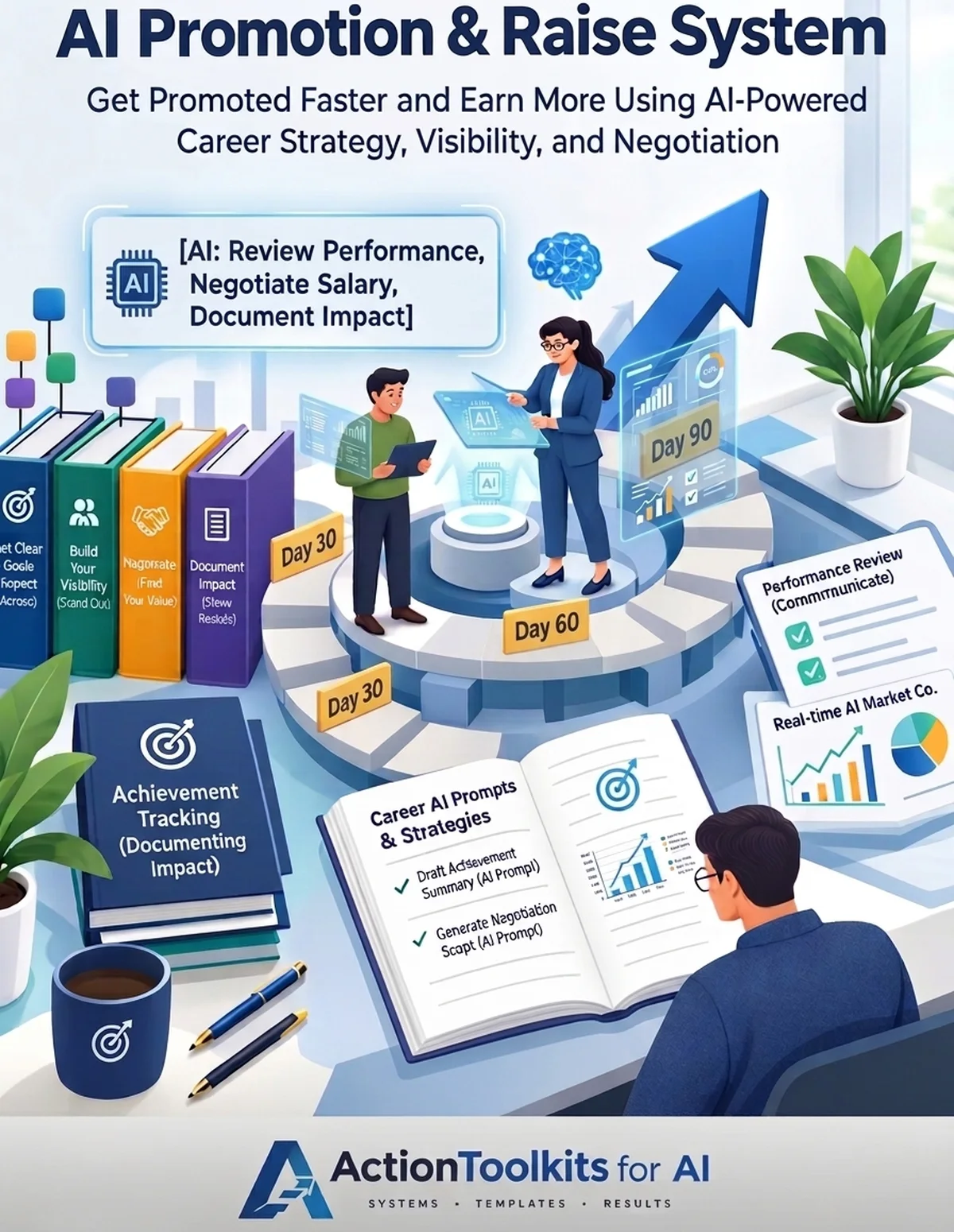
AI removes the friction: prompts that turn your scattered notes into impact statements, review prep that drills you on the questions your manager will actually ask, and a 90-day roadmap that builds your case week by week instead of in a panic before reviews. AI does not do the work for you — it removes the reason you keep skipping the work.
Where you start — this week
You do not need a strategy doc. You need a habit and a date:
- Open a "wins" log — one row a week: what you did, who saw it, what it changed.
- Each month, spend 30 minutes with AI turning those rows into quantified impact statements.
- Identify the three stakeholders who matter for your next level, and make sure they see your work.
- Mark your review on the calendar and work backward from it — that is your 90-day runway.
Four weeks of that, and you will walk into your next review with a case instead of a hope.
The honest caveat
A system cannot control politics or budget freezes. What it can do is make sure that when the decision is made, your evidence is the strongest on the table — and that you know your worth for the negotiation either way. That is a $4 decision, and it is the difference between hoping to be seen and arriving ready.
Hard work is the price of entry. The case you build is what wins the room.
The full system — 62 pages, the achievement tracking framework, stakeholder visibility plan, performance review preparation, salary negotiation prompts, and the 90-day roadmap — is in the toolkit below.