You write every day. Text messages, emails, comments, notes. And still, if someone handed you a blank page and said "write something you are proud of," you would freeze. Somewhere you learned to say "I cannot write" — and you have been saying it for years, while quietly envying the people who can.
Here is the truth: you can write. You just cannot write well enough to be proud of it — yet. That is a very different problem, and it is one that can be solved. The fear of writing is not about ability. It is about comparison: you measure your rough, unedited thoughts against someone else’s polished, published work and conclude you are not good enough. What nobody tells you is that the author of that polished piece wrote fifteen terrible drafts first.

The cost of not writing
Writing is not a niche hobby — it is how work gets done, how arguments are won, how ideas survive contact with reality. The person who can write clearly gets the promotion, closes the deal, and gets taken seriously in every meeting. The person who avoids writing because it is not "their thing" quietly hands those outcomes to someone else.
And it matters more now, not less. When AI can produce a passable draft for anyone, the differentiator is no longer who can write — it is who can write well: with a voice, with judgment, with the ability to shape raw output into something that sounds like a human who means it. That skill is becoming more valuable, not less.
How writing is actually learned
Nobody was born writing well. Every writer you admire started exactly where you are, and the only difference between them and the person who "cannot write" is that they kept going — with feedback. Real progress in writing comes from a loop:
- Write something small — a paragraph, a page, a draft you would be embarrassed to show.
- Get honest, specific feedback — what works, what is confusing, where it drags.
- Rewrite with that feedback — this is where the skill actually grows.
- Repeat — over weeks and months, the fear of the blank page becomes the habit of revision.
The reason most people never complete this loop is that they have no safe place to do it. No teacher available, no audience willing to give honest feedback on a rough draft, no structure to keep going. That is exactly what AI replaces — and why this moment is different for writers.

The mentor you never had — now available 24/7
AI is not here to write for you. It is here to teach you — the way the loop above demands:
- It explains the rules of good writing — sentences, paragraphs, stories — in plain terms, on demand.
- It gives you exercises — and never runs out of patience.
- It reads your attempts and gives honest, specific feedback — without ever making you feel judged.
- It pushes you to improve — and stays with you at 2 a.m. when no human mentor would.
With that partner, you learn five distinct writing styles, write fiction, essays, and professional pieces, and discover the voice that is actually yours — not a copy of anyone else’s.
Where you start today
You do not need inspiration or a special talent. You need ten minutes and a sentence:
- Write one honest paragraph about something you know deeply — your job, your hobby, a story.
- Ask AI to read it and tell you specifically what works and what drags — no generic praise.
- Rewrite the paragraph once, using the feedback.
- Compare your two versions — that visible improvement is the proof the loop works.
One paragraph a day, with feedback, compounds. In sixty days you will be a different writer — and you will have the evidence on the page.
The honest caveat
Sixty days of practice will not make you a published author, and anyone promising overnight mastery is lying. What it will do is take you from fear of the blank page to writing with confidence — which changes everything about how your work, your ideas, and you are received.
The only difference between a person who writes and a person who does not is that the writer kept going.
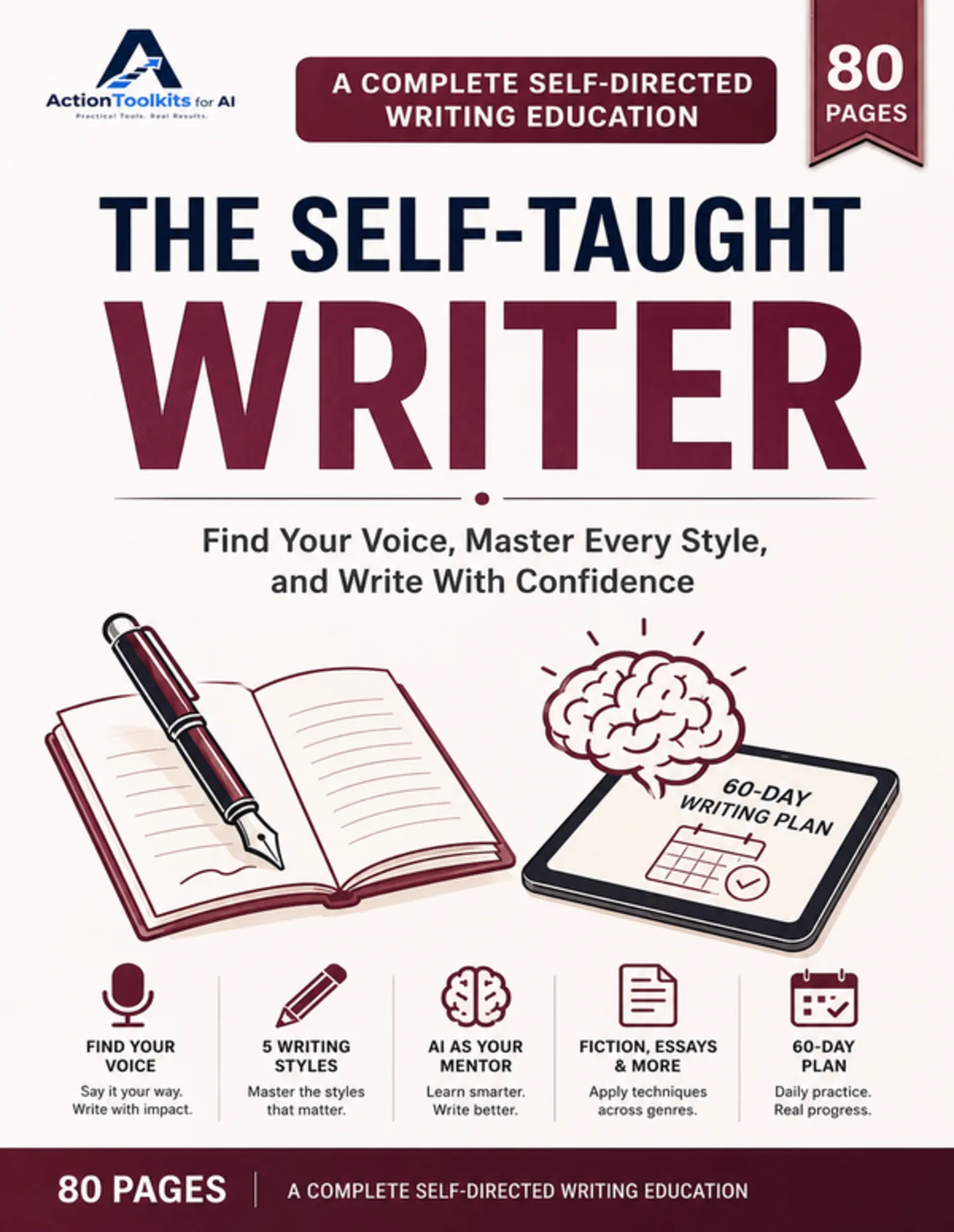
The full system — 77 pages, the AI writing mentor setup, five writing styles, fiction and essay practice, professional writing tools, voice discovery exercises, and the 60-day practice plan — is in the toolkit below.