You have been here before. You decide to eat healthier, pick a plan, follow it with good intentions for two weeks — chicken and broccoli, every night — until the boredom wins, the plan collapses, and you go back to ordering. Then the guilt arrives: why can I not just stick to it?
Here is the honest answer: most people fail at healthy eating not because they lack willpower, but because they lack a system. They pick a random diet, follow it with no structure, get bored of the food, and quietly quit. The problem is not motivation. The problem is that eating healthy has always been a guessing game — and nobody gave you the rulebook.

The daily question that wears you down
"What should I eat?" is a decision you make several times a day, every single day — under fatigue, at the moment of hunger, with whatever is in the fridge. Made one by one, with no system, those decisions lose almost every time. It is not a character flaw. It is decision fatigue stacked against you.
Eating well is a skill, and like any skill it follows a repeatable process: know your goal, understand your numbers, plan your meals, generate recipes that match your targets, shop smart, cook efficiently, track your progress. Every step can be done alone — that is why it takes so much energy. With a system, each step becomes a routine instead of a fresh decision.
Where the system actually breaks
Look closely at why your attempts failed and the pattern is always the same:
- No goal or numbers — "eat healthier" is not a target. Without a calorie and macro target, there is nothing to plan against.
- No plan — healthy food requires deciding before you are hungry, not at the moment of hunger.
- Boring food — a healthy plan you do not enjoy always collapses. Taste is not optional; it is the retention mechanism.
- No tracking — without progress data, you cannot tell what works, so you plateau and assume it is not working.
Notice that none of those are willpower failures. They are process gaps — and process gaps are fixable.

Why AI finally makes this practical
The reason healthy eating systems never stick is that they take too much work to maintain. AI changes the equation: it generates recipes that match your calorie targets and your taste preferences, builds your shopping list from the plan, and adapts when you plateau. It does not replace your judgment — it removes the busywork that made you quit.
And the honest add-on that most plans ignore: your health situation is yours. The system is designed to work alongside your doctor or nutritionist — not to replace medical advice. That is the difference between a fad plan and a system built to last.
Where you start this week
You do not need a full nutrition overhaul to begin. You need the first domino:
- Set one concrete number — a calorie target for your goal (or get it from your doctor or nutritionist).
- Plan just three dinners — not the whole week, not the whole month. Three, with recipes that hit your target.
- Generate a shopping list from those three recipes so the fridge matches the plan.
- Cook one — and notice how it feels when the decision was already made for you.
Three planned dinners next week beats a perfect plan you abandon by Tuesday.
The honest caveat
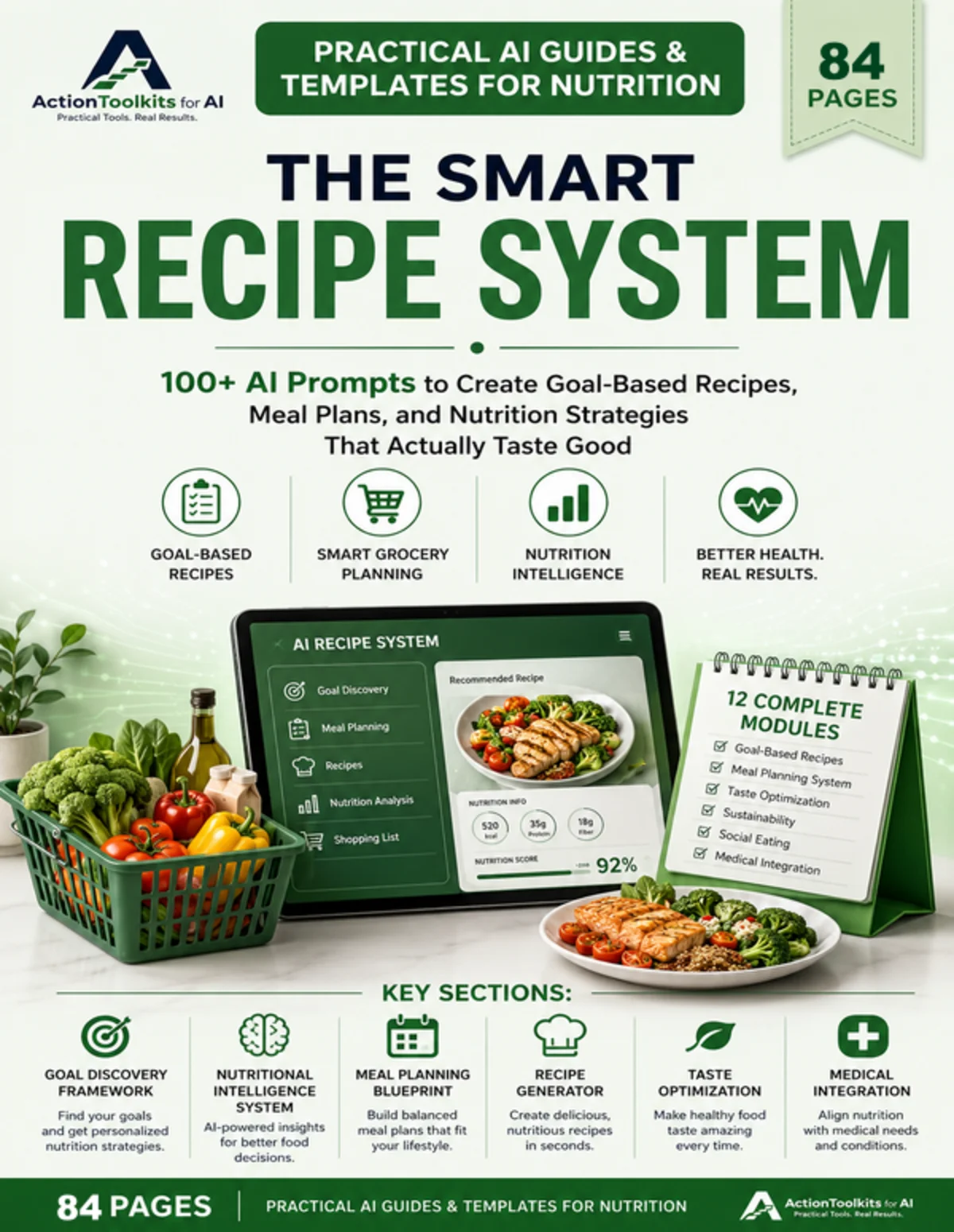
No system can replace medical guidance for real health conditions — and the good ones know it. What a system can do is end the guessing: the goals, the numbers, the meals, the shopping, the tracking, and the taste — 12 modules and 100+ prompts that adapt to your life instead of the other way around.
Eating well is a skill. Skills need a system. Systems need to taste good — or they fail.
The complete system — 79 pages, 12 modules, 100+ AI prompts, 65 ready-to-use templates: goal discovery, nutritional intelligence, meal planning, recipe generation, grocery optimization, cooking efficiency, taste optimization, progress tracking, medical integration, social eating, sustainability, and advanced AI techniques — is in the toolkit below.