The offer is on the table and you have been going back and forth for a week. Take it or not. Start it or not. Move or not. You make pro lists, con lists, you ask three friends, you read reviews — and every evening you are exactly where you started, with a little less energy and a little more doubt.
Decision paralysis is exhausting — and it is not a character flaw. It is a process problem. Nobody ever taught you a method for evaluating a big choice, so you improvise: gut feelings, pressure, whatever information is easiest to reach. And the improvisation fails the same way every time — not because you are indecisive, but because you have no system.

What the back-and-forth really costs
Paralysis is not a neutral waiting room. It has a price:
- Time — every week of indecision is a week the option changes or the market moves without you.
- Energy — the mental loop of re-litigating the same question burns more than the decision itself.
- Confidence — every postponed choice teaches your brain that you cannot be trusted to decide.
- Opportunity — while you wait for certainty, the safe options quietly expire.
And the cruelest part: the cost of a delayed decision is usually higher than the cost of a good one. A good decision made on time beats a perfect decision made late — because you can always adjust a good decision. You cannot recover the months you spent stuck.
Why you get stuck in the first place
Big decisions paralyze us for three reasons, and none of them are solved by more thinking:
- Unclear criteria — you cannot compare options against values you have never written down.
- Hidden assumptions — you "know" things about your options that you have never tested.
- Missing a verdict — you gather information but never force a conclusion, so the loop never ends.
Notice what is missing: more research. You do not need more information. You need a framework that turns information into a verdict.

The fix is a process — and it is free
Good decisions follow a repeatable pattern, and it works for any choice — career, business, relationship, relocation:
- Clarify — define what actually matters before you weigh anything. Without criteria, every factor looks equal.
- Test — use AI to challenge your assumptions and reveal the blind spots your gut is hiding.
- Score — put every option through a verdict scorecard and let the numbers force the conclusion.
Three steps. No magic. The same structure professionals use on high-stakes calls, applied to your life.
Why AI belongs in the process
AI is not there to decide for you — it is there to think with you. It asks the questions you would not ask yourself, attacks the assumptions you hold most dear, and plays the devil’s advocate you do not want to be. The result is a decision you can defend — to others and, more importantly, to yourself.
The honest caveat
No system guarantees the right choice — anyone who says otherwise is selling something. What a system does guarantee is clarity: you will know why you chose, what you weighed, and what you are betting on. That alone is worth more than another week of going back and forth.
The quality of your decisions determines the quality of your life. A good system does not guarantee perfect choices — it guarantees you make them with clarity, not chaos.
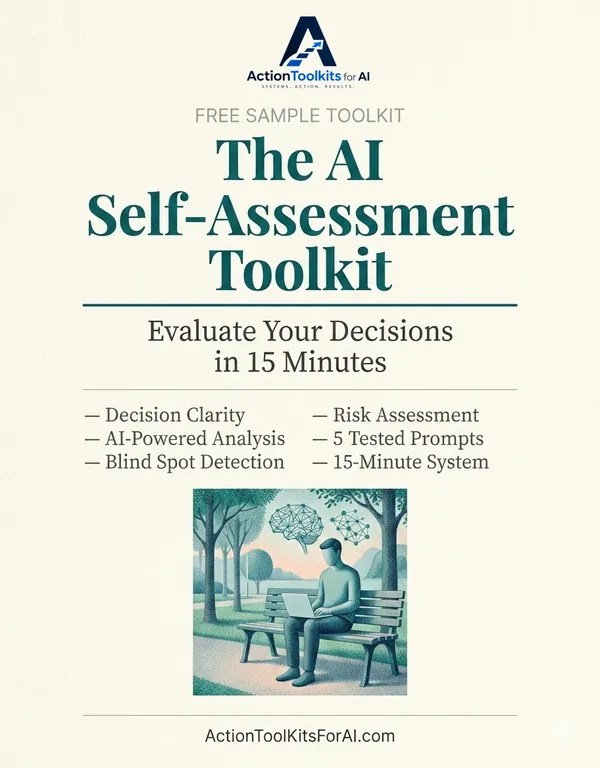
The system itself — 29 pages, 20 AI-powered tools across 5 sections, tested prompts, the decision scorecard, and the weekly/monthly review — is free. That is the honest on-ramp: see the quality of our full toolkits without paying for it.