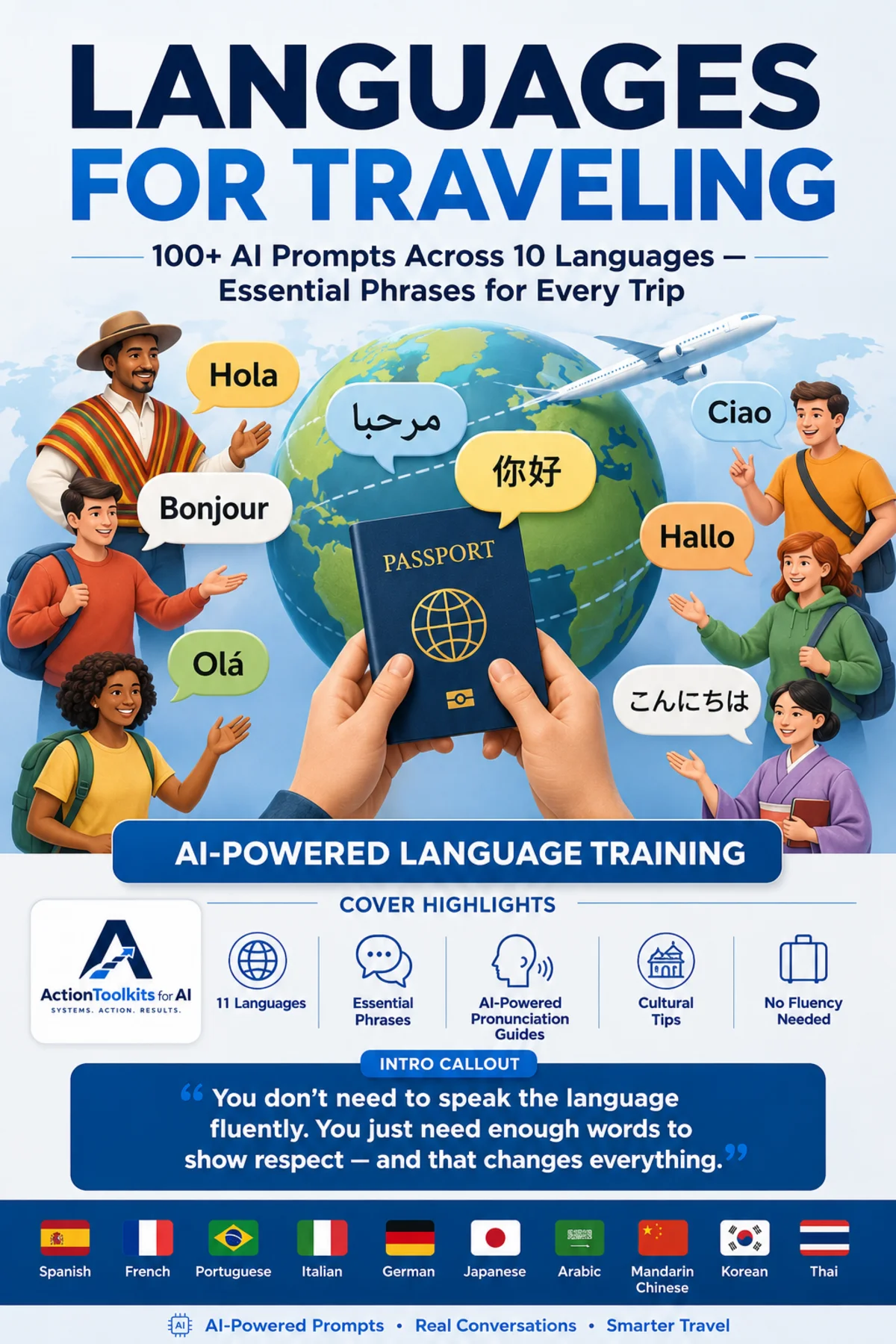
You have been there. In a country where you do not speak the language, trying to order food, ask for directions, or simply say hello — and the words are not there. You smile, you point, you hope for the best. It works sometimes. And sometimes it is the reason you end up lost at night in an unfamiliar city, or eating something you did not order.
Here is what most travelers miss: you do not need to become fluent to travel well. You just need the right phrases. A few real phrases change everything — the server lights up, the taxi driver goes the extra block, the shopkeeper treats you like a guest instead of a tourist. A handful of words opens doors that no translation app can unlock.

What pointing at your phone really costs you
Translation apps are amazing and they are not enough. The phone gets the words across, but it also keeps you a tourist: the screen between you and the person, the interaction flattened into a transaction. The difference between "please" and "sorry, my Spanish is bad, do you speak English?" is the difference between being served and being welcomed.
The gap is not vocabulary. It is confidence. Travelers who know even ten phrases walk differently — they get lost and find their way back, they order like they mean it, they have conversations that turn strangers into stories. The phrases are small. The effect on the trip is enormous.

What the right phrases actually are
You do not need to memorize a grammar book. You need the situations you will actually face, covered:
- Greetings and courtesy — the thirty seconds that decide how you are received.
- Directions — getting from "I am lost" to "you saved my evening" in five phrases.
- Food and ordering — the menu, the allergy, the "I would like" that feels like a person, not a phone.
- Shopping and emergencies — the practical moments where speed and clarity matter.
Ten phrases per situation, per language — and the trip stops being a series of hopeful guesses.
Why you have not done this yet
Be honest about the real blocker: classes are too slow, apps are too vague, and learning "some Spanish" feels like a project you will never finish before the flight. The approach changes when the goal is small and specific: not "learn Spanish," but "practice the ten phrases I will need at a Tokyo coffee shop" — that is a ten-minute task, not a course.
That is where AI makes it finally practical. You copy a prompt, paste it into any AI tool, and it becomes your personal language coach: it teaches you the phrases, corrects your pronunciation, and practices conversations with you — before you ever board. You practice ordering coffee in Japanese while you are still at home, not at the counter in Tokyo.
Where you start this week
You do not need to learn all ten languages. You need the one that matters for your next trip:
- Pick your destination — and the situation that intimidates you most (usually the biggest payoff).
- Learn the ten essential phrases for that situation — copy, repeat, hear them back.
- Run one 10-minute simulated conversation with AI playing the local.
- Repeat it once more before you fly — the words will be yours by the time you land.
Ten minutes per language, per situation. Small practice, big confidence — that is the whole system.
The honest caveat
Nothing makes you fluent overnight, and no guide should pretend otherwise. What ten phrases do is change the texture of your entire trip — from surviving to connecting. For the traveler, that is the difference that matters.
A few words open doors that no translation app can unlock.
The full guide — 98 pages, 10 languages, each one broken into the situations you will actually face as a traveler, the AI prompts that turn any AI tool into your personal coach, pronunciation coaching, and cultural tips — is in the toolkit below.