If you’ve sent out dozens of applications and heard nothing back, you already know the problem: job hunting feels like a numbers game, and the numbers aren’t in your favor. Every posting gets hundreds of applicants, and most resumes are skimmed for a few seconds before being dismissed.
The people who get interviews aren’t luckier than you. They’re more readable. AI changes the calculation — not by writing everything for you, but by making every application sharper, more targeted, and much faster to produce.
Why applying to more jobs doesn’t work
The old advice was simple: send more applications. But most resumes get filtered before a human reads them — by keyword matching, by format, by the first few lines. If your application doesn’t match what the job actually asks for, sending fifty versions of it just means fifty rejections.
The smarter move is to apply to fewer jobs, with applications built for the specific role. You’ll spend the same hours and get more interviews.
Step 1 — Build a resume that gets read
Your resume is not your career history. It’s a marketing document written for one specific job. Before you send anything, adapt the top of your resume to the job description:
- Match the exact keywords and phrases the posting uses (this is where AI shines — paste the JD and ask it to list the skills you must mention).
- Lead with quantified results (“cut onboarding time by 30%”), not job duties.
- Keep it to one page for most roles, with your most relevant experience above the fold.
- Kill the objective statement. Replace it with a 2-line summary that answers: “why you, for this role?”
Step 2 — Apply smarter, not more
Instead of 50 blind applications, send 10 that are genuinely targeted. This order works:
- Shortlist roles where your top 3 skills map directly to the requirements.
- Rewrite your summary so the first line answers “why you, for this role?”.
- Customize the first 3 bullets of your most relevant role — nothing else needs to change.
- Send the application, then follow up once after 5–7 days with a short, polite email.
A tailored application takes 20–30 minutes. It also gets a response rate that makes spam-applying look like a waste of time.
Step 3 — Prep for the interview with AI
Interviews test two things: whether you can do the job, and whether you can communicate it. Use AI as a practice partner:
- Paste the job description and ask AI to generate the questions most likely to come up.
- Practice your answers out loud, then have AI score them for structure and clarity.
- Use the STAR method (Situation, Task, Action, Result) for every behavioral answer.
- Prepare 3 real questions to ask the interviewer — it’s often what decides the offer.
Interviews aren’t about being perfect. They’re about being prepared enough to be yourself.
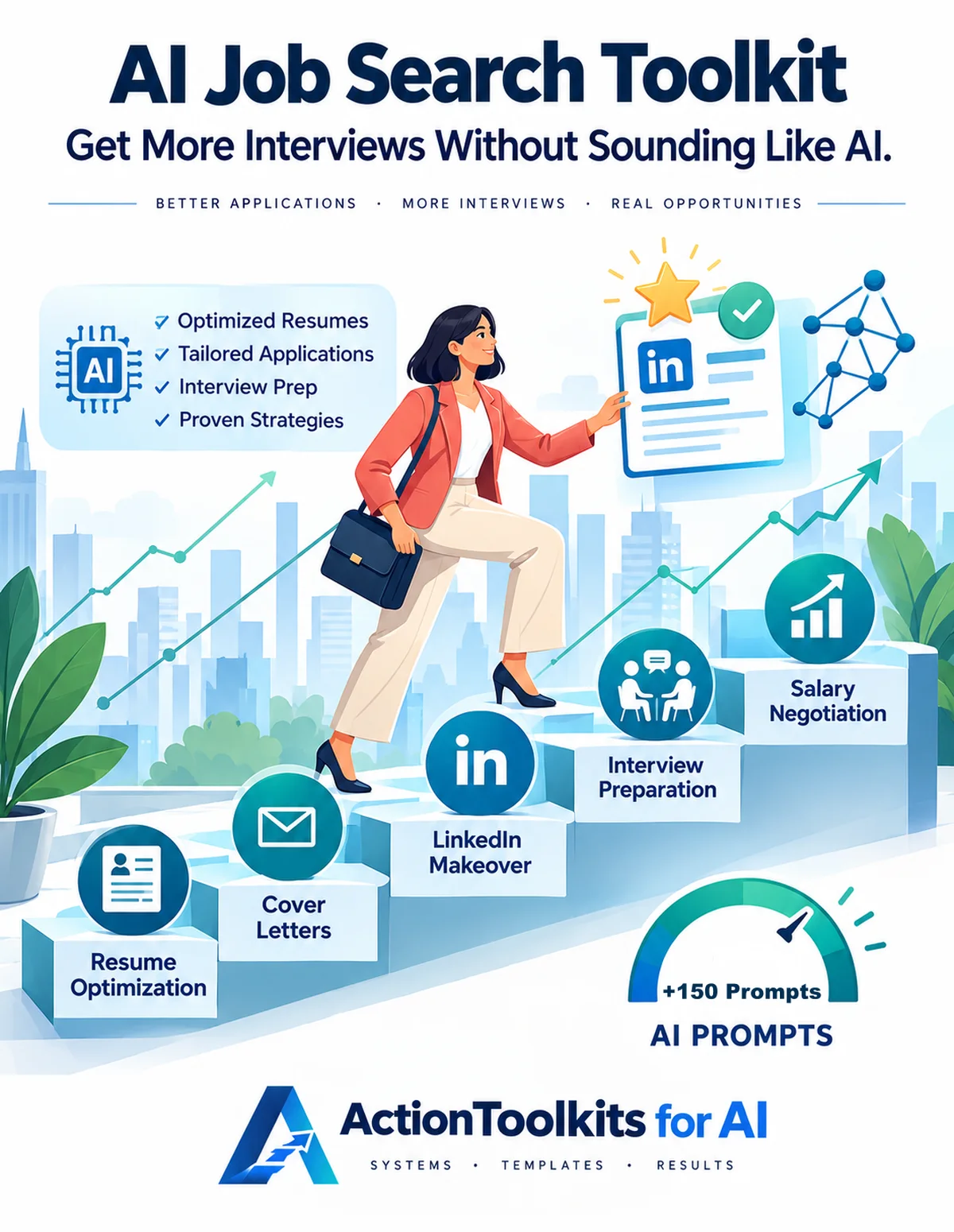
If you want all three steps as ready-made templates — the resume builder, the follow-up emails, and the interview prep script — they’re in the toolkit below.